ARCHIMEDES
Push water aside
The upward push equals the weight of the water displaced. Float when that matches your own weight.
See the numbers doodleboat
BUOYANCY, IN PLAIN ENGLISH
It is not about being light. It is about pushing water aside.
Try the salt check
AFLOATshape, not weight
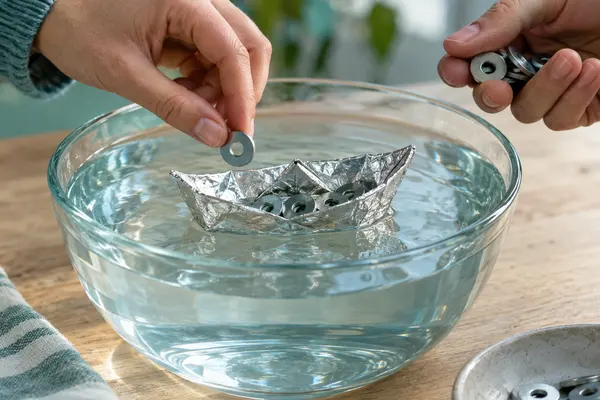
Scrunch a sheet of foil into a ball and it sinks. Fold the same sheet into a boat and it floats. The difference is how much water it pushes out of the way, and the same rule explains why cargo ships ride higher in salty seas and carry a line painted on their side.
Plain English, with the sources linked.
Updated
THE SHORT ANSWER
Water pushes up with a force equal to
the weight of the water you move aside.
ARCHIMEDES
The upward push equals the weight of the water displaced. Float when that matches your own weight.
See the numbersHULL SHAPE
Foil is denser than water, but a hull full of air has an overall density lower than water’s.
Try a foil boatSALT WATER
Seawater is heavier, cup for cup, than fresh water, so the same boat sinks in less deeply.
Try the salt checkA QUICK SALT CHECK
Put the same small boat in different waters. The saltier the water, the denser it is, and the less of it the boat needs to push aside. Salinity figures are from Woods Hole Oceanographic Institution.
The bar shows the order, not exact heights. Temperature matters too: cold seawater keeps getting denser right down to its freezing point.
TWO NUMBERS WORTH KNOWING
One small cube explains the sinking.
One painted line keeps ships from it.
2.8 g vs 1.0 g
Aluminium weight against its push from water
A one-centimetre cube of aluminium has a mass of 2.8 grams, but the water it displaces has a mass of only 1.0 gram. The push is too small, so a solid lump sinks. Spread the metal into a hollow hull and it displaces far more water.
A 1 CM CUBE · NASA
1876
The year load lines became compulsory
Overloaded, badly repaired vessels were known as “coffin ships”. Britain’s Merchant Shipping Act of 1876 made load lines compulsory, the line’s position was fixed by law in 1894, and from 1906 foreign ships visiting British ports needed one too.
THE LOAD LINE · 1876
A load line is a limit on how far a ship may sink into the water, and that depends on the water: fresh and tropical water are less dense, so their marks sit at different heights.
TRY IT AT HOME
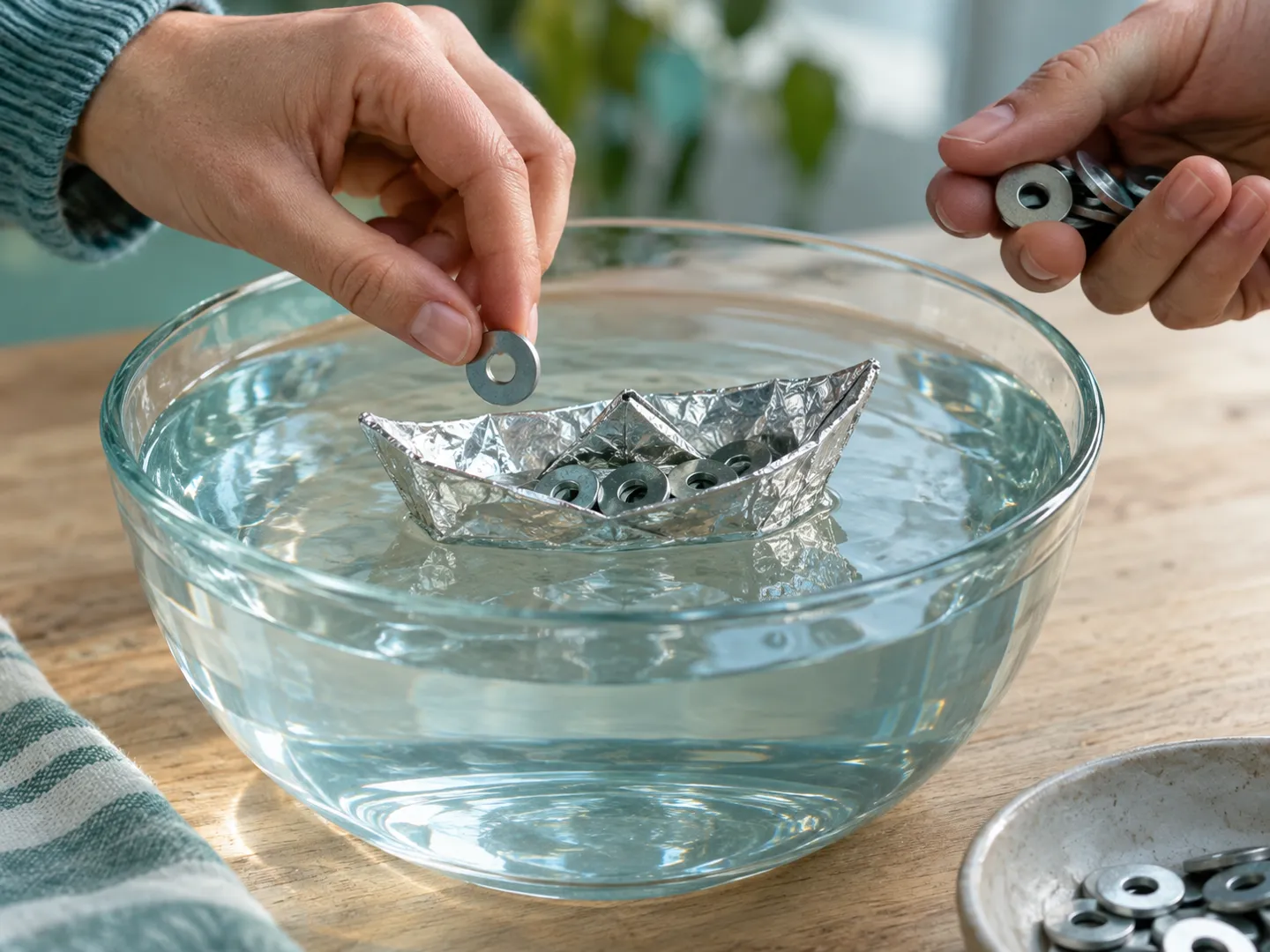
Science Buddies uses squares of kitchen foil about 30 cm and 15 cm across. Keep one square back to scrunch into a ball for comparison.
Turn up the edges to make a shallow, wide hull. The more water it can push aside before the rim goes under, the more it carries.
Add small, equal weights one at a time, spread across the floor of the hull, and count how many it takes before water spills in.
Stir plenty of salt into a second tub of water and run the same test. The denser water should hold the same hull a little higher.
FLOATING FACTS
NASA’s explanation of Archimedes’ principle: the upward force on an object in water equals the weight of the water the object displaces.
Water has a specific gravity of 1.0, so one cubic centimetre of it has a mass of 1.0 gram. Anything with an overall density above that sinks; below it, floats.
Seawater averages about 35 parts per thousand of salt: 35 grams in every 1,000 grams. Drinking water has about 0.5.
Open-ocean salinity usually tops out around 38 parts per thousand, but the Red Sea exceeds 40, while the North Pacific averages about 33.
Fresh water is densest at 4°C. Seawater becomes denser as it cools right down to its freezing point, about −1.9°C.

QUICK QUESTIONS
Short answers to the questions people ask most.
Water pushes up on anything placed in it with a force equal to the weight of the water it pushes aside. This is Archimedes’ principle. A boat floats when it has pushed aside its own weight of water before it is fully under.
Aluminium is about 2.8 times as dense as water, so a tight ball sinks. Shaped into a boat, the same foil encloses air, and the overall density of the hull and the air inside it is less than water’s, so it floats.
Yes. Seawater carries about 35 grams of salt in every kilogram, which makes it denser than fresh water. A boat has to push aside less of it to match its own weight, so it sits a little higher.
It is the load line painted on a ship’s side, a circle with a horizontal line through its centre, showing how deep the ship may safely be loaded. Britain’s Merchant Shipping Act of 1876 made load lines compulsory.
They mark separate limits for different waters and seasons: TF for tropical fresh water, F for fresh water, T for tropical, S for summer, W for winter and WNA for winter in the North Atlantic.
A NAME THAT FLOATS
doodleboat.com is part of the DoodleSale portfolio. It isn't in an auction right now, but you can ask about leasing it.